
WhatsApp has a 98% open rate. Email averages 21%. SMS sits around 28%. No other channel comes close — and for e-commerce and D2C brands, that gap represents an enormous untapped opportunity. But a high open rate alone doesn’t pay the bills. The difference between a broadcast that generates revenue and one that gets you blocked comes down to how you build your list, how you segment it, and what you say.
This guide walks you through every step — from getting set up correctly to writing messages that convert and measuring what actually matters.
Why WhatsApp Beats Every Other Broadcast Channel
WhatsApp is where your customers already spend their time. The average user opens the app more than 23 times a day. Messages feel personal — they arrive in the same place as messages from family and friends. That context creates a level of attention and trust that no email newsletter or SMS can replicate.
For brands, this translates directly to numbers. WhatsApp broadcast campaigns consistently outperform email on every metric that matters: open rates, click-through rates, and conversion rates. Brands using Baat report an average 3.8× return on spend from broadcast campaigns — driven largely by the channel’s inherent intimacy.
The caveat: that intimacy is also what makes it easy to abuse. Send irrelevant messages and customers won’t just unsubscribe — they’ll block you and report your number. A blocked number damages your WhatsApp Business quality rating, which can restrict your messaging capacity. The stakes are higher, which means the discipline required is also higher.
Getting the Foundation Right
WhatsApp Business API access
Broadcast campaigns require the WhatsApp Business API — not the regular WhatsApp Business app. The API gives you access to broadcast to unlimited contacts, use pre-approved message templates, and get delivery and read receipts at scale. Baat handles the API connection for you: connect your number, verify your business, and you’re ready to send.
Building a permission-based contact list
WhatsApp has a strict opt-in requirement. You can only broadcast to customers who have explicitly agreed to receive WhatsApp messages from you. This isn’t just a legal requirement — it’s the foundation of your deliverability. A list of genuinely opted-in customers will outperform a scraped list of 10× the size every time.
The best opt-in moments for e-commerce brands:
- Checkout — add a WhatsApp checkbox alongside email opt-in
- Order confirmation page — “Get order updates on WhatsApp”
- Website pop-up or widget — especially effective with a first-order discount
- QR code on packaging — captures post-purchase customers at peak satisfaction
- Click-to-WhatsApp ads on Facebook and Instagram
Track your opt-in source for every contact. Customers who opted in via order updates behave very differently from those who opted in for a discount — and that difference should shape how you communicate with each group.
Segmenting Your Audience
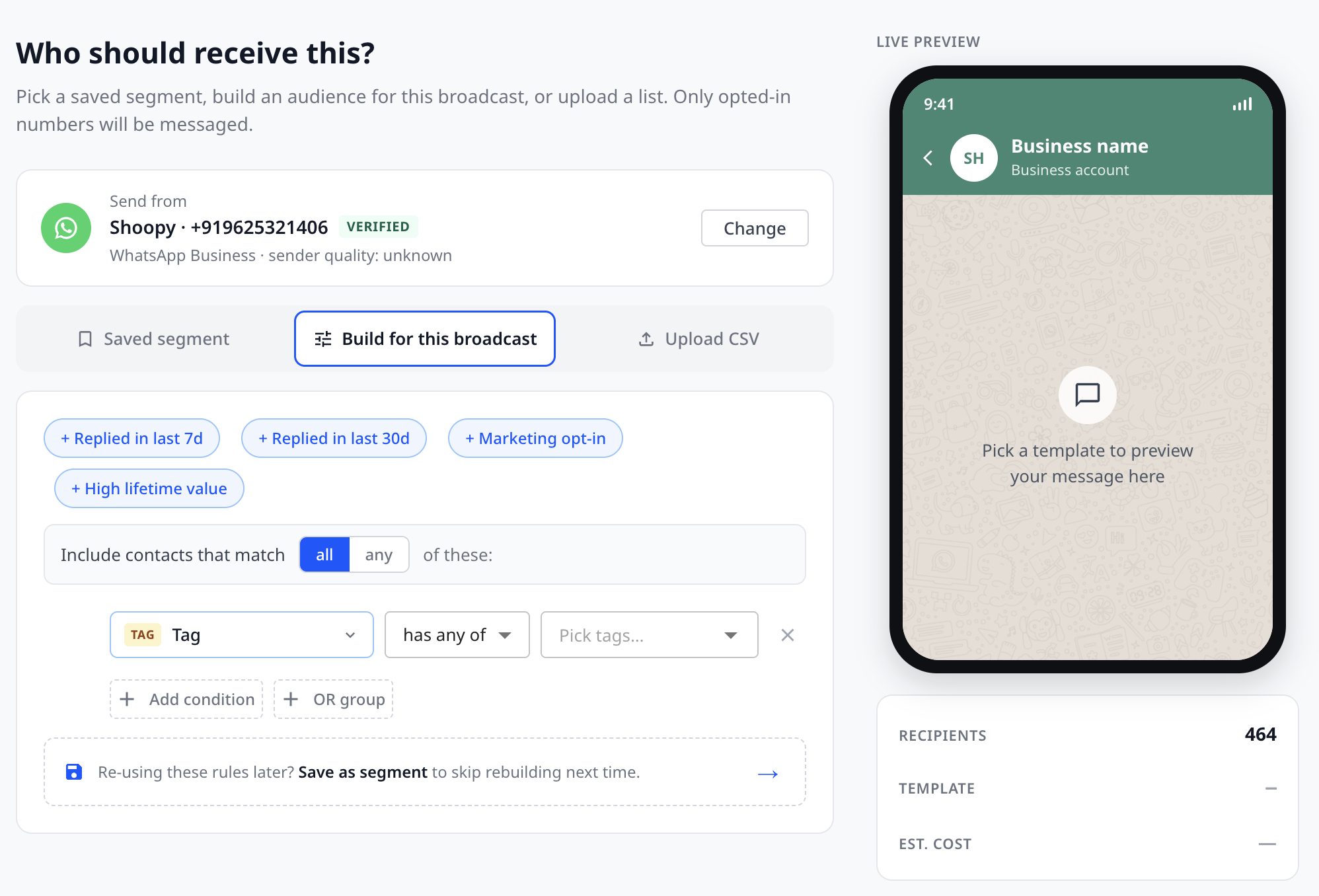
Blasting your entire list with the same message is the fastest path to low engagement and high block rates. The brands getting the best results from WhatsApp are sending highly relevant messages to tightly defined segments — sometimes as small as a few hundred customers.
Segments to build first
Recent buyers (last 30–90 days): Your warmest audience. They’ve purchased, they trust you, and they’re the most likely to buy again. These customers respond well to new arrivals, restocks of categories they’ve bought in, and loyalty offers.
Lapsed customers (90–180 days since last purchase): High-value to win back. A personalised message referencing their last order — “It’s been a while since your last order of [product]” — consistently outperforms generic re-engagement messages.
High-value customers (top 20% by lifetime value): Treat these customers differently. Early access to sales, exclusive previews, and VIP messaging. They convert at higher rates and respond poorly to the same promotions you send everyone else.
Cart abandoners: This segment has the highest conversion rate of any broadcast type when triggered correctly. Pair it with Shopify integration to trigger cart recovery messages automatically within 30 minutes of abandonment.
Behavioural triggers vs scheduled broadcasts
Not all broadcasts are created equal. There are two types: scheduled (you pick a date and time, everyone in the segment receives it at once) and triggered (sent automatically when a customer performs an action). Triggered messages almost always outperform scheduled ones because they arrive at the exact moment of relevance.
Baat supports both. Use scheduled broadcasts for campaigns — sales, new arrivals, seasonal events. Use triggered broadcasts for cart recovery, back-in-stock alerts, and post-purchase sequences.
Writing Messages That Convert
WhatsApp messages are read in a messaging context — not an inbox. The writing style that works is conversational, direct, and short. Here’s what separates high-converting WhatsApp copy from mediocre copy:
Lead with the value, not your brand
Don’t start with “Hi, this is [Brand]!” — that reads like a cold email. Start with what’s in it for the customer. “Your favourite moisturiser just dropped 20%” beats “We’re running a flash sale” every time. The customer’s name and a product or category reference in the first line dramatically improves read-through.
Keep it to 3–4 sentences maximum
WhatsApp is not the place for a 200-word message. The most effective broadcasts are three to four sentences: a hook, a one-line explanation, a clear call to action, and an optional scarcity element (“offer ends midnight”). Anything longer drops off in engagement sharply.
One link, one action
Give customers exactly one thing to do. One link, one button, one ask. Messages with multiple links see significantly lower tap rates on each individual link than messages with a single clear CTA.
Use personalisation variables
Baat lets you insert contact variables — first name, last purchased product, city — directly into your message templates. A message that says “Hey Sarah, your Vitamin C Serum is almost out — reorder now and get free shipping” will outperform a generic “Reorder your favourite products” by a significant margin. Personalisation isn’t a nice-to-have on WhatsApp; it’s expected.
Timing Your Broadcasts
When you send matters almost as much as what you send. WhatsApp messages are read quickly — typically within 5 minutes of delivery. That means you need to send when customers are in a mindset to act, not just in a mindset to read.
Based on aggregate data from Baat campaigns, these time windows consistently perform best:
- Weekday mornings, 9–11 AM: Customers are starting their day and checking messages. Good for informational campaigns and new arrivals.
- Weekday lunch, 12–2 PM: High tap-through rates. Good for flash sales and time-sensitive offers.
- Sunday evenings, 7–9 PM: Surprisingly strong for lifestyle and repeat-purchase categories. People are relaxed and browsing.
Avoid Friday evenings and Saturday mornings — engagement drops noticeably. And never send between 10 PM and 8 AM. Messages that arrive overnight feel intrusive when customers wake up to them, and block rates spike.
Test your own audience’s patterns. Look at which campaigns had the highest reply and tap rates and note the time of send. Your customer base will have its own rhythm.
WhatsApp Template Compliance
All outbound broadcast messages on WhatsApp must use pre-approved message templates. Templates are submitted to Meta for review and typically approved within 24–48 hours. There are a few things that will get your template rejected:
- Promotional language without an opt-out option
- Templates that could be used for spam or phishing
- Overly aggressive sales language in the first message in a sequence
- Missing variable fallbacks (if you use {{first_name}}, you need a fallback for when the name isn’t known)
Baat’s template builder has built-in compliance checks that flag potential issues before you submit. It also tracks template approval status and notifies you when templates are approved or need changes.
Measuring What Matters
WhatsApp gives you richer signal than email. Beyond delivery and open rates, you get:
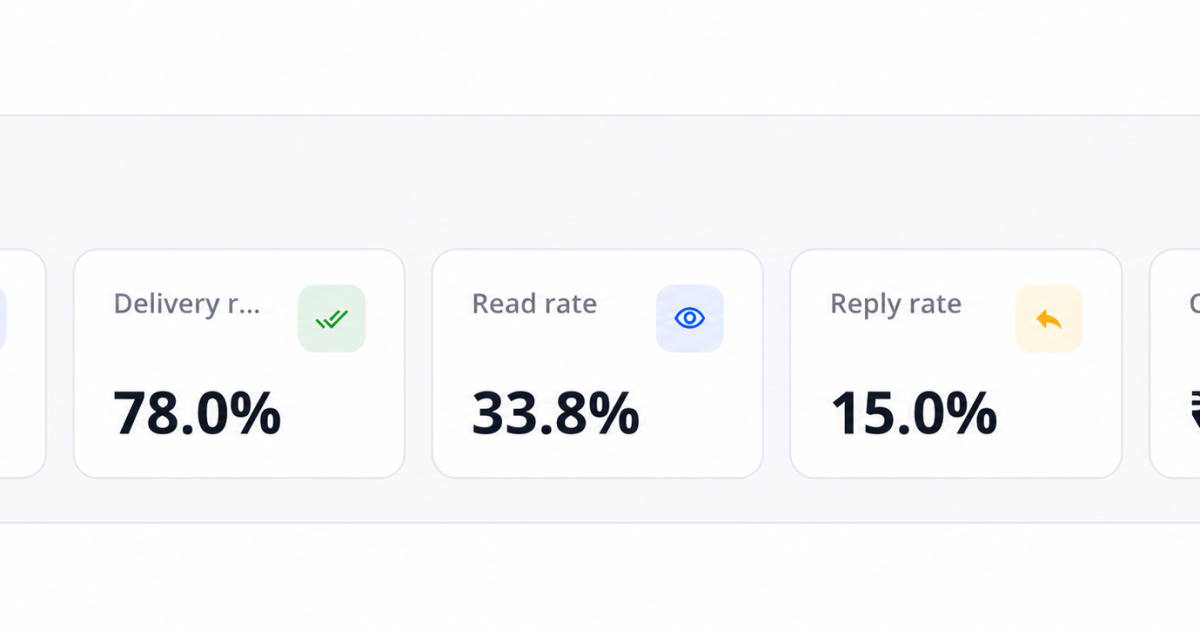
- Read rate: The percentage of delivered messages that were actually opened (the blue tick confirmation). A healthy read rate is 60–80%.
- Reply rate: How many recipients responded. Even a 2–5% reply rate is exceptional — it means the message created enough engagement to prompt a response.
- Tap-through rate: Clicks on your CTA link. A well-segmented campaign to a warm audience should see 10–20% tap-through.
- Block rate: The percentage of recipients who blocked your number after receiving the message. Keep this below 0.5%. If it spikes above 1%, review your segmentation and message relevance immediately.
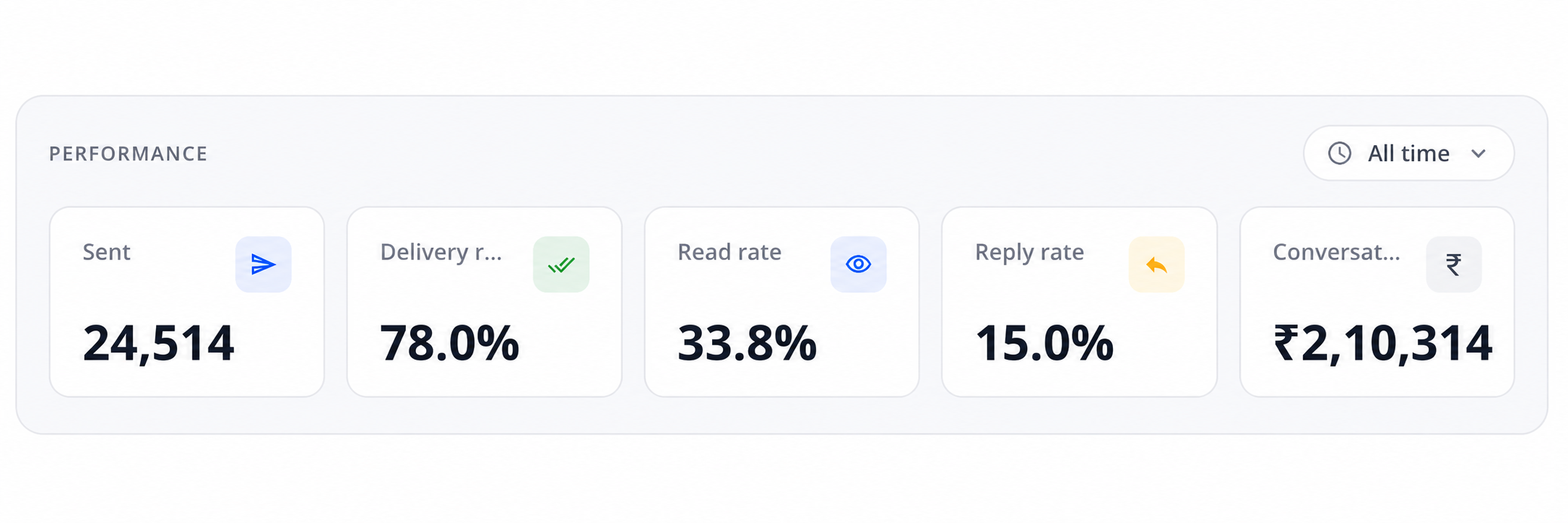
Track revenue per broadcast directly by appending UTM parameters to your links. Baat’s analytics dashboard shows all of these metrics per campaign and lets you compare performance across segments and time periods. When a customer replies to a broadcast, route it straight to your team with shared inbox — high-intent replies handled within an hour convert at significantly higher rates.
Common Mistakes to Avoid
Sending to your full list every time. The fastest way to burn your list is to send every campaign to everyone. Irrelevant messages lead to blocks, and blocks damage your number’s quality rating. Always ask: who is this message actually relevant for?
Ignoring replies. When a customer replies to a broadcast, that’s a high-intent signal. Brands that respond to replies within an hour see significantly higher conversion rates from those customers.
Sending too frequently. There’s no universally correct send frequency — it depends on your category and audience. As a baseline, most brands find that one to two broadcasts per week is sustainable without significant list fatigue. Watch your unsubscribe and block rates; if they trend up, dial back.
Not testing templates before a big send. Always send to a small internal test group first. Check that personalisation variables resolve correctly, links work, and the message renders as expected on different devices.
Frequently Asked Questions
What is a WhatsApp broadcast campaign?
A WhatsApp broadcast campaign is a one-to-many message sent from a WhatsApp Business API number to a list of opted-in contacts simultaneously. Unlike group chats, each recipient receives the message as a private one-on-one conversation. Broadcasts require pre-approved message templates and can only be sent to contacts who have explicitly opted in to receive messages from your brand.
How is WhatsApp broadcast different from a WhatsApp group?
In a WhatsApp group, all members can see each other and each other’s replies. In a broadcast, each recipient receives the message privately — they see it as a direct message from your business, with no visibility into other recipients. Replies go only to you. This makes broadcasts far more effective for marketing: they feel personal, not like a group announcement.
What is a good open rate for WhatsApp broadcast campaigns?
A healthy read rate (WhatsApp’s equivalent of an open rate) is 60–80% for a well-maintained, permission-based list. This compares to an industry average of 20–25% for email. If your read rate is consistently below 50%, review your opt-in quality and message relevance — the list may contain contacts who have forgotten they opted in, or the content may not match their expectations.
How many WhatsApp broadcasts can I send per day?
The WhatsApp Business API uses a tiered messaging limit system. New numbers start at Tier 1 (1,000 unique contacts per day) and can scale to Tier 2 (10,000/day), Tier 3 (100,000/day), and unlimited, based on your phone number quality rating and messaging volume over time. Maintaining a high quality rating — achieved by keeping block rates low and engagement rates high — is the key to scaling your broadcast capacity.
Do I need customer consent to send WhatsApp broadcasts?
Yes. WhatsApp’s Business Policy requires explicit opt-in consent from every contact before you send them marketing messages. Consent must be specific to WhatsApp (a generic email newsletter opt-in does not count) and must be documented. Sending to contacts who haven’t opted in risks your number being reported, which can result in a reduced quality rating or permanent messaging restrictions.
What is the best time to send a WhatsApp broadcast?
Based on aggregate campaign data, weekday mornings (9–11 AM) and lunch hours (12–2 PM) consistently deliver the highest tap-through rates for promotional broadcasts. Sunday evenings (7–9 PM) perform well for lifestyle and repeat-purchase categories. Avoid late nights (after 10 PM) entirely — messages that arrive overnight spike block rates when customers wake up to them.